




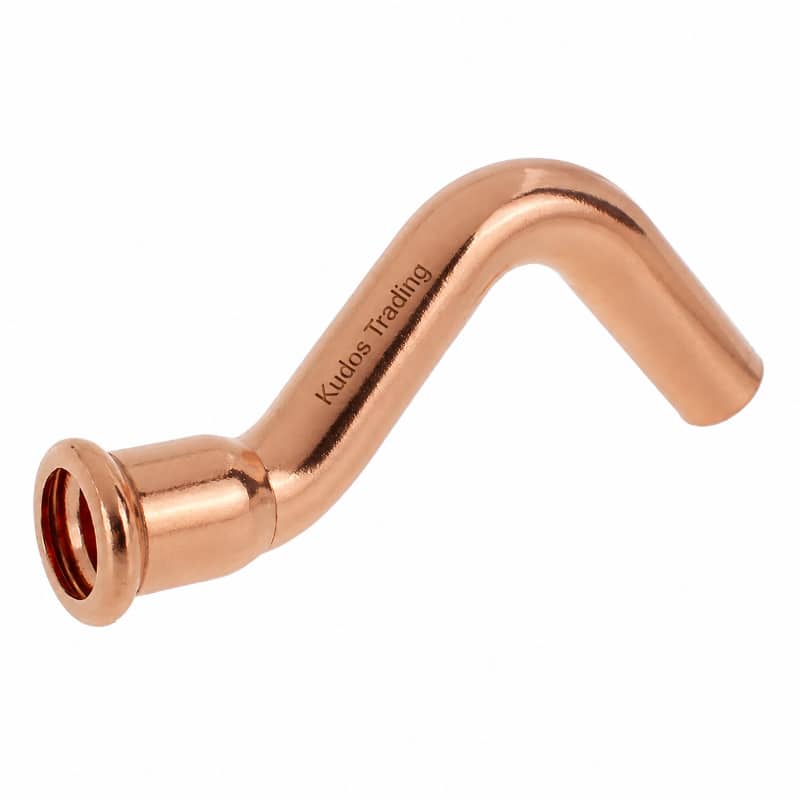
M Press Copper Part Crossover
The M Press Copper Part Crossover provides a neat way to create an offset in compatible copper pipework. Its preformed shape helps installers route copper tube around another pipe or suitable obstruction without forming a complex bend on site.
Unlike a full crossover, the part crossover forms only part of the complete offset. Therefore, installers can use the fitting with the surrounding copper pipework to achieve the required route.
The fitting combines a press connection with a plain copper tail. Consequently, it provides additional flexibility when connecting into compatible M Press pipework.
Furthermore, the M profile press connection removes the need for soldering, flux or a blowtorch. This makes the fitting particularly useful for water, plumbing and compatible heating installations where neat pipe routing and reduced hot works are important.
Why Choose an M Press Copper Part Crossover?
Creates a Neat Pipe Offset
The preformed shape helps copper pipework move around another pipe or suitable obstruction.
Compact Crossover Solution
A part crossover provides a convenient alternative to creating an offset from several separate fittings.
Press Connection and Plain Tail
The fitting combines an M profile press socket with a plain copper end. Therefore, it can integrate neatly into compatible copper press installations.
Reduced On-Site Pipe Bending
The crossover shape is already formed. Consequently, installers can reduce the amount of manual pipe forming required.
No Soldering Required
The press connection uses mechanical jointing. Therefore, installers do not need solder or flux.
No Naked Flame
M Press technology eliminates the need for a blowtorch at the press joint. As a result, it helps reduce traditional hot works.
Key Features
- M Press copper part crossover
- Preformed offset design
- Helps pipework pass around another pipe
- Ideal for copper pipe routing
- Compact crossover solution
- M profile press connection
- Plain copper tail
- Suitable for compatible copper tube
- Reduces complex on-site bending
- Useful in restricted spaces
- Suitable for water applications
- Suitable for compatible heating systems
- No soldering required
- No flux required
- No blowtorch required
- Reduced hot works
- Fast mechanical connection
- Clean professional appearance
- Suitable for new installations
- Ideal for refurbishment projects
- Useful for pipework alterations
- Suitable for domestic plumbing
- Suitable for commercial plumbing
- Compatible M profile pressing equipment required
Technical Specification
- Product: M Press Copper Part Crossover
- Product Type: Part Crossover / Pipe Offset Fitting
- Connection: M Press Socket and Plain Copper Tail
- Press Profile: M Profile
- Pipe Material: Compatible Copper Tube
- Application: Water, Plumbing and Compatible Heating Systems
- Function: Creating a Partial Offset Around Another Pipe or Suitable Obstruction
- Jointing Method: Mechanical Press Connection
- Soldering Required: No
- Flux Required: No
- Open Flame Required: No
- Press Tool Required: Yes
- Press Jaw Required: Correct Size M Profile Jaw
Always confirm fitting dimensions, copper tube specification and system compatibility before installation.
What Is an M Press Part Crossover?
An M Press Part Crossover is a preformed copper fitting that creates part of an offset within a pipe run.
The formed section moves the pipe away from its original route. Therefore, installers can use it to help navigate around another pipe or suitable obstruction.
Unlike a full crossover, a part crossover does not form the complete crossover shape within one fitting.
Instead, it provides part of the required directional change.
Consequently, it gives professional installers greater flexibility when creating compact copper pipe layouts.
Part Crossover vs Full Crossover
Both fittings help route copper pipework around another pipe or obstruction. However, their designs differ.
M Press Copper Part Crossover
A part crossover creates part of the required offset.
Therefore, it provides flexibility when the surrounding pipework forms the remainder of the crossover.
It can be particularly useful where the installer needs to control the final pipe position.
M Press Copper Full Crossover
A full crossover contains the complete offset within the fitting.
The pipe moves away from its original route and then returns to the original line.
Therefore, a full crossover provides a predetermined complete crossover shape.
The correct fitting depends on the required pipe route and available installation space.
What Is a Copper Part Crossover Used For?
Copper pipework often needs to navigate around existing services.
For example, a new pipe may need to pass around another water or heating pipe.
Creating the required shape manually can take additional time and working space.
A part crossover provides a preformed section of the required offset.
Therefore, it can prove useful when routing around:
- Existing copper pipe
- Heating pipework
- Water pipework
- Closely positioned services
- Suitable small obstructions
- Existing plumbing installations
Ideal for Pipework Crossovers
Several copper pipes often run alongside each other.
However, their positions may need to change as the installation progresses.
For example, one pipe may need to move from one side of another pipe to the opposite side.
A part crossover helps create the necessary offset.
Consequently, installers can maintain an organised pipe layout without constructing every change from several separate elbows.
Part Crossover vs Multiple Elbows
An installer can create an offset using elbows and short pieces of copper tube.
However, this approach introduces additional components and connections.
A purpose-designed part crossover provides the required formed section within one fitting.
Therefore, it can offer several practical benefits:
- Fewer separate fittings
- Fewer individual connections
- Reduced installation time
- Neater pipe routing
- Consistent crossover shape
- Compact installation
- Professional appearance
Part Crossover vs Bending Copper Pipe
Suitable copper tube can also be bent to create offsets.
However, manual bending requires suitable equipment and enough space to form the pipe correctly.
Furthermore, achieving consistent bends can require careful measurement.
The M Press Part Crossover provides a preformed alternative.
Therefore, installers can achieve a controlled offset without manually creating the complete bend.
Understanding the Plain Copper Tail
The part crossover incorporates a plain copper tail rather than a press socket at both ends.
The plain tail can connect into another suitable fitting where the dimensions and system specification allow.
Therefore, it can help create compact fitting combinations.
The plain section itself does not contain a press seal.
Instead, when inserted into another compatible press fitting, the receiving fitting creates the press connection.
Always confirm compatibility and insertion requirements before assembly.
Copper Press Fittings for Water
M Press fittings provide a mechanical method of joining compatible copper tube.
The installer prepares the pipe, inserts it into the press socket and completes the connection using compatible M profile pressing equipment.
Therefore, the joint does not require traditional soldering.
M Press copper fittings can form part of suitable:
- Hot water pipework
- Cold water pipework
- Water distribution
- Domestic plumbing
- Heating installations
- Plant rooms
- Commercial plumbing
- New build projects
- Refurbishments
- Maintenance work
No Soldering Required
Traditional copper installations frequently use soldered fittings.
However, M Press technology creates mechanical connections.
Therefore, installers do not need:
- Solder
- Flux
- Blowtorch
- Naked flame at the press joint
Consequently, professional installers can retain copper tube while using a modern press jointing system.
Reduced Hot Works
Working with a blowtorch can require additional precautions, particularly around existing building materials.
For example, copper pipe may sit close to timber, insulation or finished surfaces.
M Press technology avoids applying a naked flame to the press connection.
Therefore, it can prove particularly useful during renovation, maintenance and alteration work.
Ideal for Restricted Spaces
Creating complex pipe bends can be difficult where working space remains limited.
A preformed part crossover can simplify the required pipe route.
Therefore, it can prove particularly useful in:
- Boiler cupboards
- Service cupboards
- Utility rooms
- Plant rooms
- Existing plumbing systems
- Heating installations
- Refurbishment projects
- Confined service areas
Always check the physical dimensions of the crossover before installation.
Ideal for Neat Surface Pipework
Visible copper pipework benefits from accurate routing.
Therefore, preformed fittings can help installers maintain a consistent appearance.
A part crossover provides a controlled offset instead of relying entirely on hand-formed bends.
Consequently, it can help create professional pipework in areas where the installation remains visible.
Ideal for Heating Pipework
Heating systems often contain several copper pipes running close together.
Therefore, one pipe may occasionally need to pass around another.
A part crossover provides a useful way to begin or complete the required offset.
Typical applications can include:
- Boiler pipework
- Heating distribution
- Radiator systems
- Cylinder installations
- Plant rooms
- Pump arrangements
- Valve assemblies
Correct system design and pipe sizing should always determine the final layout.
Ideal for Plumbing Alterations
Existing properties often contain complex pipe routes.
New copper pipework may need to navigate around existing services without completely rearranging the installation.
Therefore, a part crossover can provide additional routing flexibility.
Furthermore, its M Press connection removes the need for soldering at the press joint.
As a result, the fitting works particularly well for refurbishment and maintenance projects.
How to Install an M Press Copper Part Crossover
Firstly, plan the required pipe route carefully.
Check that the crossover provides the correct offset and sufficient clearance around the pipe or obstruction.
Next, prepare the compatible copper tube.
Cut the pipe squarely using a suitable copper pipe cutter.
Then, remove internal and external burrs.
Inspect the copper tube and fitting for damage or contamination.
Mark the required insertion depth where specified.
Push the copper tube fully into the M Press socket.
Next, check the insertion mark.
Position the correct size M profile press jaw around the designated pressing section.
Complete the full pressing cycle.
If the plain tail connects into another compatible press fitting, insert it to the correct depth.
Then, press the receiving fitting according to its installation requirements.
Finally, inspect all completed connections before commissioning the system.
Check Crossover Clearance Before Pressing
The crossover has a predetermined shape.
Therefore, installers should check its position before making the permanent press connection.
Confirm that the fitting provides sufficient clearance around the pipe or obstruction.
Furthermore, consider any pipe insulation or additional space requirements.
Correct planning helps prevent unnecessary alterations after pressing.
Always Deburr Copper Pipe
Freshly cut copper tube can contain sharp burrs.
Therefore, installers should deburr the tube before inserting it into the press socket.
Correct preparation helps protect the fitting’s internal sealing components.
Furthermore, a properly prepared pipe can enter the fitting smoothly and reach the correct insertion depth.
Mark the Correct Insertion Depth
Correct insertion remains essential for a reliable press connection.
Therefore, mark the required depth on the copper tube where specified.
The mark provides a clear visual check before pressing.
Furthermore, it helps identify any pipe movement while positioning the press jaw.
If the plain crossover tail enters another press fitting, check that connection’s insertion depth as well.
Use the Correct M Profile Jaw
The press connection requires compatible M profile pressing equipment.
Before pressing, confirm:
- Fitting size
- Copper tube size
- M press profile
- Correct jaw size
- Press tool compatibility
- Jaw condition
- Pipe insertion depth
- Correct jaw position
Never substitute another press profile simply because it appears to fit around the fitting.
Manual or Powered M Press Tool?
A suitable manual M Press tool may be used where the tool and jaw are compatible with the exact crossover size.
Alternatively, powered press equipment can provide faster operation when completing larger installations.
Therefore, always confirm tool, jaw and fitting compatibility before pressing.
M Press Part Crossovers for Plant Rooms
Plant rooms frequently contain several water and heating pipes within a restricted area.
Consequently, pipe routes sometimes need to cross or move around other services.
A part crossover provides another option for creating these directional changes.
It can prove particularly useful around:
- Boilers
- Cylinders
- Pumps
- Valves
- Manifolds
- Heat exchangers
- Heating controls
- Water distribution pipework
Furthermore, M Press technology helps reduce traditional hot works within the installation area.
M Press Part Crossovers for Commercial Installations
Commercial buildings can contain extensive copper distribution pipework.
Therefore, installers may encounter numerous areas where pipes need to pass around other services.
M Press Copper Part Crossovers can form part of compatible installations within:
- Hotels
- Apartment developments
- Offices
- Schools
- Retail properties
- Public buildings
- Plant rooms
- Residential developments
- Commercial refurbishments
- Maintenance projects
Furthermore, the preformed design helps installers create consistent pipework layouts.
Complete M Press Copper Fitting System
The M Press Copper Part Crossover forms part of a wider copper press fitting range.
Therefore, installers can combine compatible M Press fittings to create:
- Straight connections
- 45° direction changes
- 90° direction changes
- Pipework crossovers
- Pipework offsets
- Equal branches
- Reduced branches
- Pipe size reductions
- Pipe terminations
- Threaded transitions
Using compatible M profile fittings throughout the installation also provides a consistent mechanical jointing method.
Why Buy From Kudos Trading?
Kudos Trading supplies professional plumbing, heating and underfloor heating products throughout the UK.
With more than 25 years of relevant industry experience, we understand the products and support professional installers need.
Furthermore, our growing M Press copper range allows customers to source fittings alongside compatible tools and pipe preparation equipment.
Choose Kudos Trading for:
- Extensive M Press copper fitting range
- Professional plumbing and heating products
- Competitive UK pricing
- Fast nationwide delivery
- Practical technical support
- Friendly customer service
- More than 25 years of industry experience
- Support before and after your purchase
Frequently Asked Questions
What is an M Press Copper Part Crossover?
It is a preformed copper fitting designed to create part of an offset when routing compatible pipework around another pipe or suitable obstruction.
What is a part crossover used for?
It helps installers create controlled pipe offsets and crossovers without forming the entire shape manually.
What is the difference between a part crossover and full crossover?
A full crossover contains the complete offset and returns the pipe to its original line. In contrast, a part crossover creates only part of the offset.
Does a part crossover connect the crossing pipes together?
No. A crossover changes the route of one pipe. It does not create a connection between the two crossing pipe runs.
Can it be used to pass around another copper pipe?
Yes. This is one of its main applications. However, always check the available clearance before installation.
Does the fitting have a plain copper end?
Yes. The part crossover combines a press connection with a plain copper tail.
How does the plain tail connect?
It can enter another compatible fitting where the dimensions and system specification allow.
Do I press the plain tail itself?
No. If the plain tail enters another M Press fitting, the press operation takes place on the receiving fitting.
What press profile does the fitting use?
The press connection requires compatible M profile equipment.
Does it require soldering?
No. The M Press connection uses mechanical pressing.
Do I need a blowtorch?
No. A naked flame is not required for the press connection.
Is the fitting suitable for water?
Yes. It is intended for compatible copper water and plumbing applications.
Can it be used on heating pipework?
Yes, where the fitting and complete system specification permit the intended water-based heating application.
Can it replace several elbows?
In suitable layouts, a preformed crossover can reduce the need for multiple elbows and short pipe sections.
Can it replace a manually formed pipe bend?
Yes, where the crossover dimensions suit the required pipe route.
Do I need to deburr the copper pipe?
Yes. Correctly prepare and deburr copper tube before inserting it into a press socket.
Should I mark the insertion depth?
Yes, where specified. The mark provides a useful visual check before pressing.
Can I use a U profile jaw?
No. Use the specified compatible M profile pressing equipment.
Can I use a manual M Press tool?
Yes, provided the tool and M profile jaw support the exact fitting size.
Is a part crossover useful in plant rooms?
Yes. It can help route compatible copper pipework around other services in complex plant room installations.
Related Products
- M Press Copper Full Crossovers
- M Press Copper Equal Tees
- M Press Copper Reducing Tees
- M Press Copper Reducing Couplers
- M Press Copper Fitting Reducers
- M Press Copper Straight Couplers
- M Press Copper Sleeve Couplings
- M Press Copper 90° Elbows
- M Press Copper 90° Street Elbows
- M Press Copper 45° Elbows
- M Press Copper 45° Street Elbows
- M Press Copper End Stops
- Manual M Press Tool
- M Profile Press Jaws
- Copper Pipe Cutters
- Pipe Reamers & Deburring Tools
Next Working Day Delivery: Yes, we hold all our products in stock at our 7000 sq ft Nottingham warehouse and at our 3000 sq ft warehouse in Market Harborough and use DPD for a tracked next-day delivery.
Collection Available: You can always collect from our Norttinagham location and help yourself to a free tea and coffee


